A dissertation is the biggest piece of work most students have ever planned on their own. Nobody sets weekly deadlines, the hand-in date is months away, and for the first few weeks it feels as if there’s plenty of time. Then it’s March.
This guide is about the plan behind the work: how to turn one date into a weekly routine you can actually keep. It’s written for undergraduate and master’s dissertations and final-year projects, with a note for PhD students at the end. If what you need right now is a Gantt chart for your proposal, our guide to Gantt charts for a dissertation covers that in detail.
The short version: find your real dates and the marking criteria. Count the weeks you actually have once exams, holidays and some spare time are taken out. Make your question fit those weeks. Plan the next four weeks in detail and the rest as phases. Agree it with your supervisor, then spend 15 minutes on it every Friday.
Before you plan: find three things
1. Your dates. The hand-in date, and every earlier deadline your department sets: the proposal, an ethics application, an interim report or progress review, a presentation, poster or viva. They’re usually in the module handbook or on the module’s page in your university’s learning platform (Blackboard, Moodle or Canvas). These dates don’t move, so the rest of the plan fits around them.
2. What’s being marked. The marking criteria describe what a first-class dissertation looks like in your department. The literature review, methods, analysis, critical discussion and presentation are often judged separately. Read them now, not in April: they tell you where your time should go.
3. The rules. The word limit and what counts towards it (references, appendices, tables), the referencing style, formatting, and how to submit. Five minutes now saves a stressful evening later.
Step 1: Count the weeks you really have
Count back from the hand-in date to today. Then take off the weeks you won’t be working on it: holidays, exams and revision, weeks when other coursework is due, and about 10% of the total as spare time before hand-in for illness, late data and the printer queue.
Here’s a final-year student who starts on 28 September and hands in on 30 April:
| Weeks | |
|---|---|
| 28 September to 30 April | 31 |
| Christmas break | −2 |
| January exams and revision | −3 |
| Easter | −1 |
| Weeks when other coursework is due | −2 |
| Spare time before hand-in (10%) | −3 |
| Weeks to plan with | 20 |
Twenty weeks, not thirty-one. That’s the number to plan with. It’s less than it looked, which is exactly why planning helps.
Step 2: Make the question fit the time
The most common reason a dissertation runs late isn’t laziness. It’s a question that’s too big for the weeks available. Signs yours is too big:
- it needs data you don’t have access to yet, or can’t be sure of getting
- it needs a method you haven’t learned
- you can’t say in one sentence what you expect to find out
- your supervisor’s first reaction is “that sounds like a PhD”
Narrow it to one group, one setting, one method or one time period. “How do engineering students plan?” becomes “How do first-year engineering students plan group projects, and what makes their plans slip?” A narrow question answered well scores better than a broad one answered thinly.
Step 3: Lay out the phases
Almost every dissertation goes through the same phases: topic and proposal, ethics (if you work with people), literature review, methodology, data collection or building, analysis, writing, revisions, and formatting and hand-in. They overlap, and writing runs alongside the work rather than after it. How much of your time each phase usually takes is in our Gantt chart guide, and the free Gantt chart template applies those shares to your own dates.
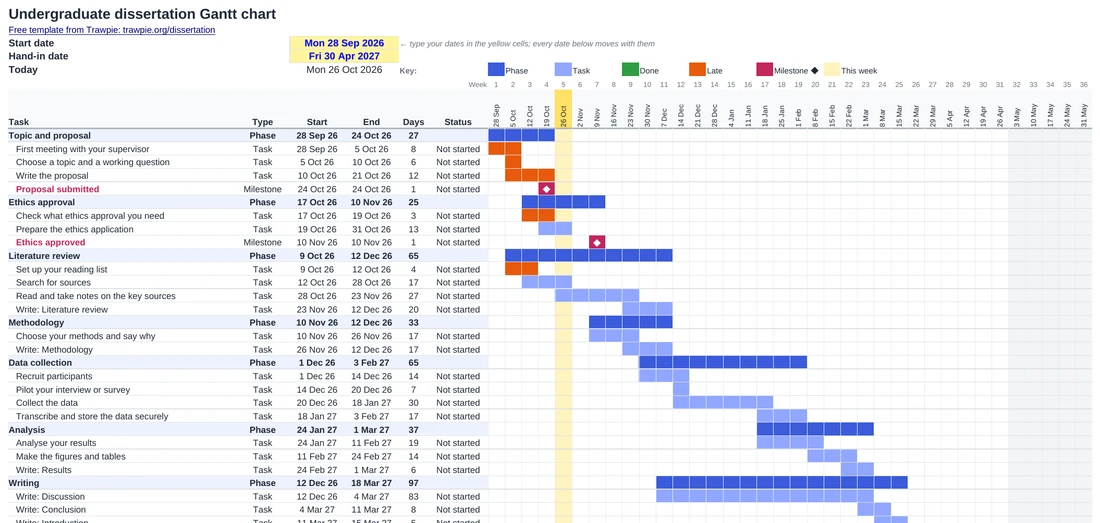
A few rules of thumb hold whatever your subject:
- Get the proposal in early, in roughly the first tenth of your time. Everything else waits on it.
- Apply for ethics approval as soon as your methods are clear. It can take weeks, and you can’t collect data before it.
- Protect your data collection window. If your participants are students, don’t plan interviews for exam season.
- Send the full draft to your supervisor about 80% of the way in, so there’s time to act on what they say.
Step 4: Plan the next four weeks in detail, the rest in outline
You can’t plan week 18 in detail in October, because you don’t yet know what your reading will turn up. So plan the next four weeks as tasks you can tick off, and leave the rest as phases with end dates. Every Friday, add another week of detail at the far end.
A good task is something you can finish in a sitting or two: “Read and summarise five sources on group planning”, not “Literature review”. Here’s what the first four weeks might look like:
| Week | Tasks |
|---|---|
| 1 | Read the handbook and marking criteria · list three possible topics · book a first meeting with your supervisor |
| 2 | First supervisor meeting · choose a topic and a working question · set up a reference manager (Zotero, Mendeley or EndNote) |
| 3 | Search the databases with your keywords · read and summarise five key sources · check whether you need ethics approval |
| 4 | Draft the proposal · send it to your supervisor with one specific question · put the proposal deadline in your calendar |
Step 5: Plan the writing too
Give every chapter a word target. For a 10,000-word dissertation, a common split is:
| Chapter | Words |
|---|---|
| Introduction | 1,000 |
| Literature review | 2,500 |
| Methodology | 1,500 |
| Results | 2,000 |
| Discussion | 2,000 |
| Conclusion | 1,000 |
| Total | 10,000 |
Check your department’s guidance: some fold the literature review into the introduction, and engineering projects often have design, implementation and testing chapters instead of results.
Write in this order: the literature review and methodology while you’re reading and designing, the results as you analyse, then the discussion and conclusion. Write the introduction and abstract last; you can’t introduce something you haven’t written yet.
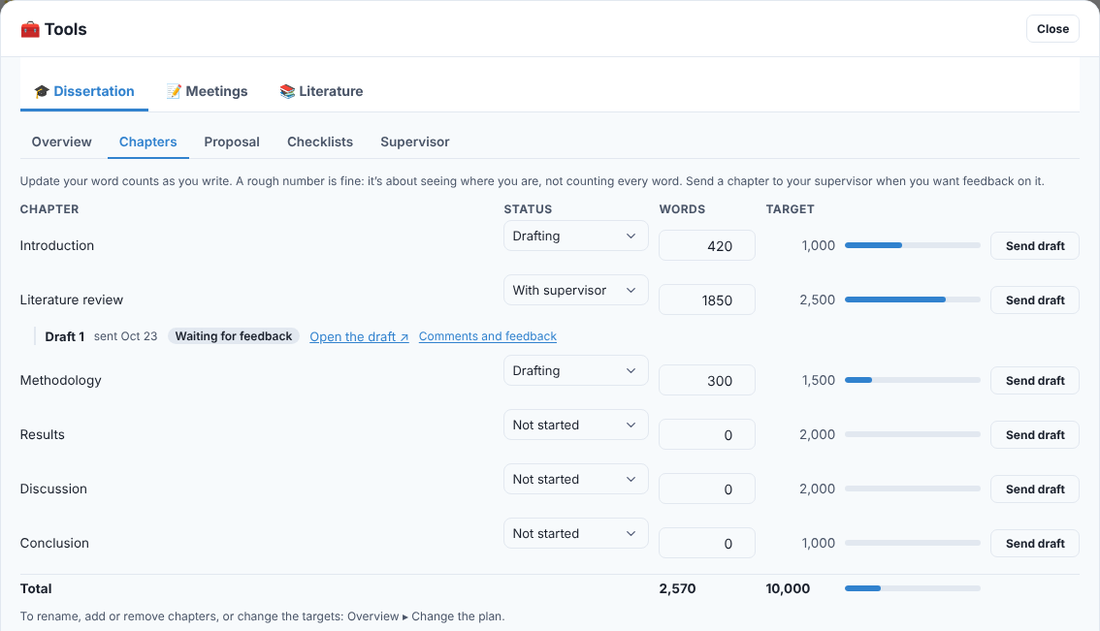
Little and often beats a heroic weekend. 300 words a day, four days a week, is 1,200 words a week: a complete first draft of 10,000 words in under nine weeks. Note your word count for each chapter once a week; a rough number is enough.
Step 6: Agree the plan with your supervisor
Take your plan to your first or second supervisor meeting and ask three questions: are these dates realistic, is the question the right size, and what do you want to see from me, and when? Agree how often you’ll meet and how to book a slot.
Before each meeting, send a short note: what you’ve done since last time, your questions, and what you’d like feedback on. Afterwards, write down the actions you agreed, each with a date, and put them in your plan.
Send drafts chapter by chapter, not all at once in March. Each time, ask one specific question, such as “Does grouping the studies by theme work?”, and ask when you can expect feedback. Allow about two weeks.
Step 7: Review it every Friday
Fifteen minutes at the end of each week keeps the plan alive:
- Tick off what you finished.
- Move what you didn’t to next week, and ask yourself why it slipped.
- Update your word counts.
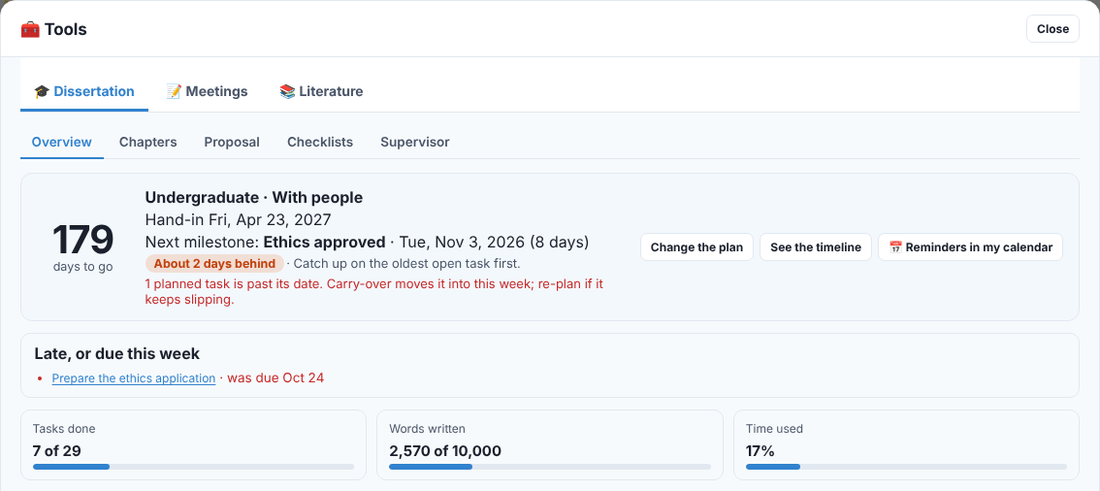
- Look at the next milestone. Are you still on course for it?
- Plan next week’s tasks.
When you fall behind
You will, at some point. What matters is noticing early.
- A week behind: don’t panic. Catch up over the next two weeks.
- Two or three weeks behind, or the same task slipping again and again: re-plan with your supervisor. Cut scope, not your spare time or your writing time: fewer interviews, a smaller dataset, one experiment instead of two.
- Something outside your control, like illness, a family emergency or data that never arrives: tell your supervisor, and ask about your university’s process for extensions or mitigating circumstances straight away. These processes usually need evidence and have deadlines of their own.
The last month
- Every chapter drafted, and your supervisor’s feedback worked through
- References complete and in the right style; everything cited is in the list, and everything in the list is cited
- Figures and tables numbered and mentioned in the text
- Word count within the limit, counted the way your department says
- Abstract, contents page, acknowledgements and any declaration your university asks for
- Formatted as the handbook says
- Backed up in two places, such as your university OneDrive and a USB stick
- Submitted a day early, with the receipt saved
Master’s and PhD
Master’s: often the same plan squeezed into one summer. If you need ethics approval, apply in the first fortnight, because waiting for it can swallow a big part of a short project. Keep the full draft to your supervisor about 80% of the way in, and keep your spare time even when it hurts.
PhD: plan the three or four years in phases, and only the current term in weeks. Your milestones are the upgrade or confirmation review, annual reviews, submission and the viva. Re-plan properly at each review: what you learned in year one should change year two.
Tools that help
A spreadsheet is fine. Start from our free dissertation Gantt chart template for Excel or Google Sheets: type your two dates and the plan fits itself to them.
If you’d rather the plan kept itself up to date, the Trawpie dissertation planner does the steps above for you. It builds a week-by-week plan from your hand-in date, with tasks and checklists, chapter word counts and a proposal helper. Your supervisor can give feedback on chapter drafts, and the planner tells you whether you’re on track. It’s free for undergraduate, master’s and PhD students.
Your dissertation stays yours. Trawpie never writes any part of it. Universities treat AI-written work as academic misconduct, so it helps with the part that’s fair game: planning, keeping track and keeping going.
Related: Gantt charts for a dissertation or final-year project · How to plan a student engineering project