How it works
- Tell us the basics. Undergraduate, master’s or PhD; your start and hand-in dates; any deadlines your university has set (proposal, ethics, full draft, upgrade, viva); and the kind of research you’re doing.
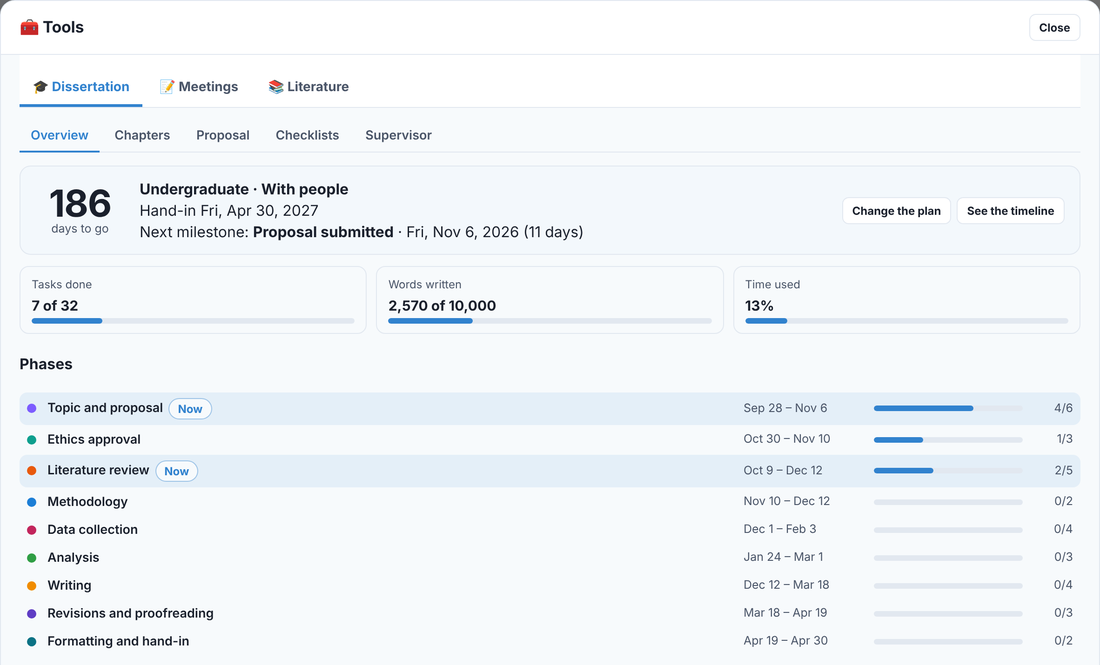
- Get a week-by-week plan. Trawpie spreads the work across the time you have, with about 10% spare before hand-in: topic and proposal, ethics if you need it, literature review, methods, data or building, analysis, writing, revisions and formatting. Every task has a date and a short checklist.
- Keep going. Tick off tasks each week, update your word counts, and let anything unfinished carry into the next week on its own. If a task keeps slipping, you’ll see it long before the deadline does.
For undergraduate, master’s and PhD
Undergraduate
Final-year dissertations and projects, usually over your final year.
- Proposal and supervisor meetings first
- A 10,000-word structure you can change
- Engineering projects get Design, Implementation and Testing chapters
Master’s
Often one busy summer, or a year part-time. The plan fits whichever you have.
- A tighter timeline with a full draft about 80% of the way in
- 15,000 words by default
- Ethics, data and analysis scheduled around it
PhD
Three or four years, planned as phases with weekly tasks as you go.
- Upgrade or confirmation review, annual reviews
- Studies, papers and conferences
- Writing up, submission, the viva and corrections
A typical dissertation timeline
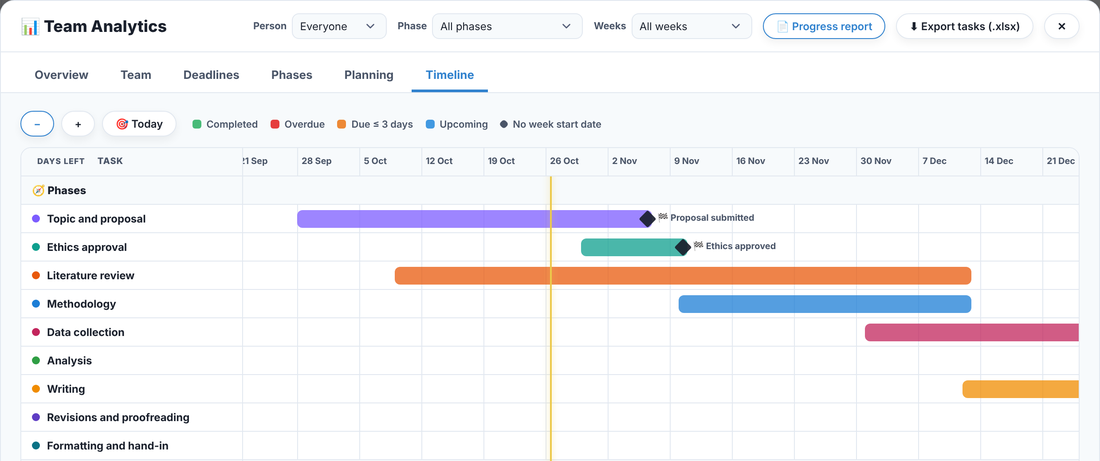
Here’s how Trawpie spreads an undergraduate or master’s dissertation across the time you have. With seven months, “the first 12%” is about the first three and a half weeks. Your own university dates take priority.
| When | Phase | Done means |
|---|---|---|
| First 12% | Topic and proposal | A working research question, a first supervisor meeting, the proposal handed in |
| 8–18% | Ethics (if you work with people) | Information sheet, consent form, data plan, approval |
| 5–35% | Literature review | A reading list, notes on the key sources, a draft chapter |
| 20–35% | Methodology | Methods chosen and justified, a draft chapter |
| 30–60% | Data, building or experiments | The data collected, or the thing built and tested, and backed up |
| 55–72% | Analysis | Results, figures and tables |
| 35–80% | Writing | Every chapter drafted; the full draft with your supervisor |
| 80–95% | Revisions and proofreading | Feedback worked through, references checked, read aloud |
| Last 5% | Formatting and hand-in | Your department’s format, the word count, a receipt |
Everything a dissertation needs, in one place
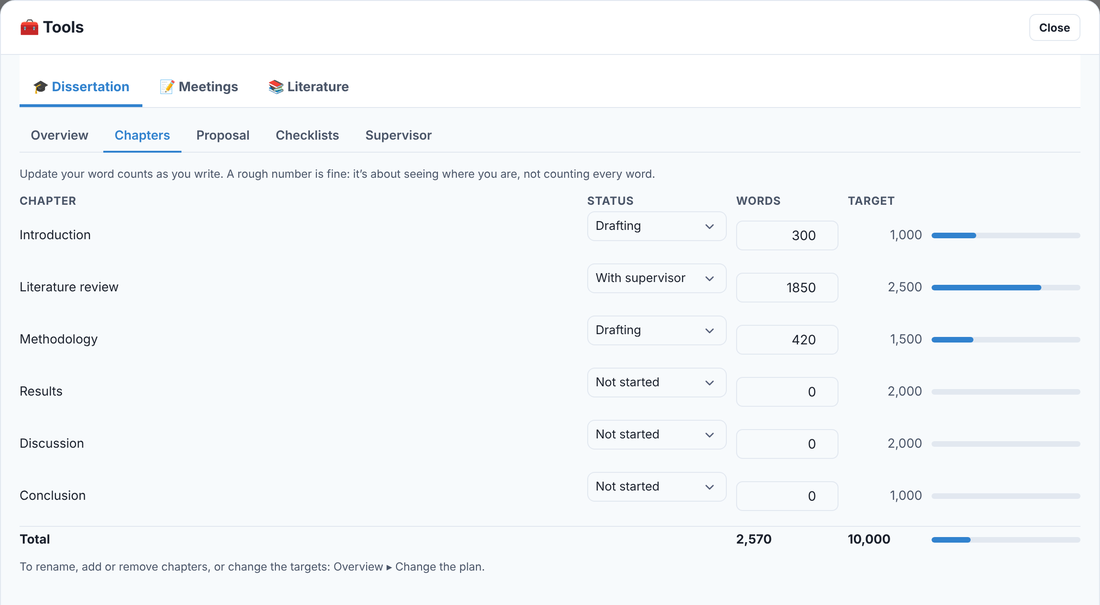
Chapters and word counts
Each chapter has a target, a status (drafting, with your supervisor, revising, final) and the words you’ve written. It’s not about counting every word; it’s about knowing where you are.
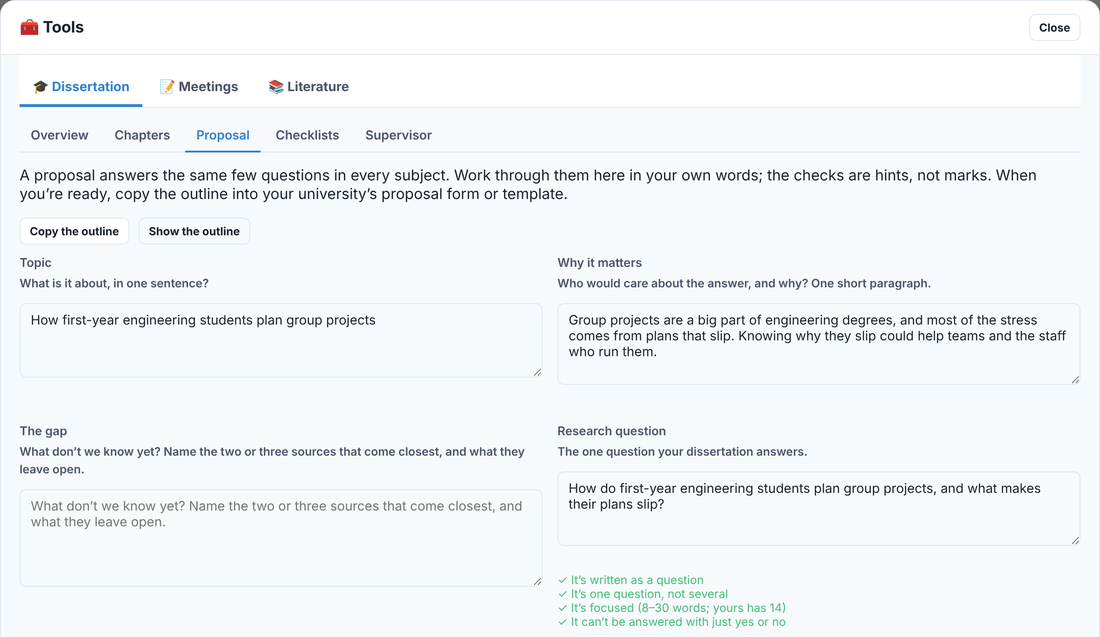
A proposal helper that leaves the writing to you
A proposal answers the same few questions in every subject: what, why, the gap, your question, your aims, your methods, ethics and timeline. Trawpie walks you through them and gives gentle hints, like whether your question can be answered with a yes or no, or whether your objectives start with a verb. Then it puts your words into an outline you can paste into your university’s form.
Supervisor meetings that turn into actions
Before each meeting, note your progress and questions; afterwards, the next steps you agreed become tasks with dates. Invite your supervisor and they can see your plan and progress and comment, without being able to change anything.
Reading, checklists and the rest
- Reading list: add papers by DOI, track what you’ve read, and export BibTeX for LaTeX, Zotero or Mendeley.
- Checklists: ethics, everything to check before you hand in, and viva preparation.
- Lab notebook: dated notes and photos on any task, handy for experiments and builds.
- Calendar: put your deadlines in Google Calendar or Outlook.
Prefer a spreadsheet? Download our free dissertation Gantt chart template for Excel and Google Sheets.
Your work stays yours. Trawpie never writes your dissertation, your proposal or any part of them. Universities treat AI-written work as academic misconduct, so we help with the part that’s fair game: planning, keeping track and keeping going.
Questions
Is it free?
Yes. Planning your dissertation or thesis in Trawpie is free, and students get Pro Education free too.
Does it write my dissertation?
No. It helps you plan, track and keep going. Every word is yours, which is exactly what your university expects.
Can my supervisor see my plan?
Only if you invite them. A supervisor sees your plan, chapters and progress and can comment, but can’t change anything. You can also give them tasks, like “Read chapter 2”.
Does it work for a PhD?
Yes. A PhD plan covers all three or four years in phases: the literature review and research questions, training, ethics, a pilot, the upgrade or confirmation review, your studies, papers and conferences, annual reviews, writing up, submission, the viva and corrections. The weeks on the board start with your first term and grow as you go.
What if my deadlines change?
Change the dates and the plan updates. Your word counts and ticked checklists are kept, and unfinished tasks carry into the next week on their own.
Can I use my department’s chapter structure?
Yes. Rename, add or remove chapters and set your own word targets. Engineering final-year projects start with Design, Implementation and Testing chapters; literature-based dissertations start with themes instead of results.
Start your plan
It takes about two minutes. You’ll need your hand-in date; everything else is optional.
More help: How to plan a dissertation from your hand-in date · How to plan a student engineering project · How to use Trawpie