A Formula Student season is a year-long engineering project squeezed around lectures, exams and a summer that arrives far too quickly. Most teams don't lose time on hard engineering problems. They lose it in small, invisible slips: a drawing that was "nearly done" for three weeks, a part nobody ordered, a test day that never happened.
This guide lays out a season as a timeline you can actually run, with the checkpoints that catch slippage early. It's written with a UK season in mind, where the main competition is usually at Silverstone in July, but the shape works for any event: work backwards from your competition date and adjust.
The short version: freeze the design early, order long-lead parts before you think you need to, put the car on the ground months before competition, and treat the static events as real deliverables with owners and deadlines. Always check your competition's current rules and handbook for exact deadlines.
The season at a glance
Here's a typical season for a team aiming at a July competition. Shift the months to fit your own date.
| When | Phase | Done means |
|---|---|---|
| Sep–Oct | Kick-off and recruiting | Sub-teams and leads named, last year's lessons written down, season goals agreed |
| Oct–Nov | Concept and targets | Car-level targets (mass, power, lap time), system layouts, the budget plan |
| Nov–Jan | Detailed design | CAD and analysis per system, design reviews passed, long-lead parts ordered |
| Jan–Feb | Design freeze | Signed-off drawings, a full bill of materials, manufacturing plan |
| Feb–Apr | Manufacture and assembly | Chassis, then systems, then a rolling car |
| Apr–Jun | Testing and driver training | Shakedown, reliability runs, setup data, drivers trained |
| All season | Static events | Design report, cost and manufacturing submission, business plan, all to their deadlines |
| July | Competition week | Scrutineering passed, dynamic events run, a car that finishes |
1. Kick-off: start the season with names, not intentions
The first few weeks set the tone for the year. New members are enthusiastic but don't know where to start; returning members remember everything that went wrong last time but nobody has written it down.
- Write a one-page lessons-learned list from last season while it's fresh: what broke, what was late, what you'd never do again.
- Name a lead for every sub-team (chassis, suspension, powertrain, electronics, aero, business) and give every new member a first small task in their first week.
- Agree three season goals as a team. "Finish endurance" is a better goal than "win" if you didn't finish last year.
2. Concept and targets: decide what the car is before you draw it
Teams that skip this step end up with systems that don't fit together. Set car-level targets first (target mass, power, wheelbase, a lap-time estimate) and let each sub-team derive its own targets from those. Write them down as requirements, so a design review later can ask a simple question: does this meet the target?
This is also when the budget gets real. Rough out the cost of every system and compare it with the money you actually have. If it doesn't fit, cut scope now, not in March.
3. Detailed design: reviews, not just CAD
Detailed design is where most seasons quietly slip. CAD always feels "90% done". The fix is to give each system a design review with a date and a named reviewer: a senior member, a faculty adviser or an industry mentor. A review isn't a formality; it's the point where someone other than the designer says yes, this is ready to make.
- Give every system a design review date on the timeline, with an owner.
- Keep a short checklist per review: loads checked, rules checked, manufacturable, costed.
- Order long-lead parts during design, not after freeze. Engines, motors, batteries, dampers, tyres and electronics often take weeks or months to arrive.
4. Design freeze: the date that saves your season
Pick a hard design-freeze date and protect it. After freeze, changes go through the sub-team lead and the chief engineer. They're not banned, but they're deliberate. Without a freeze, design keeps "improving" until there's no time left to build.
At freeze you should have signed-off drawings, a complete bill of materials with costs, and a manufacturing plan that says who makes what, where, and by when.
5. Manufacture and assembly: plan it week by week
Manufacturing is the most people-heavy part of the season, and the one where coordination matters most. Workshop time, machine bookings, supplier deliveries and exam timetables all collide.
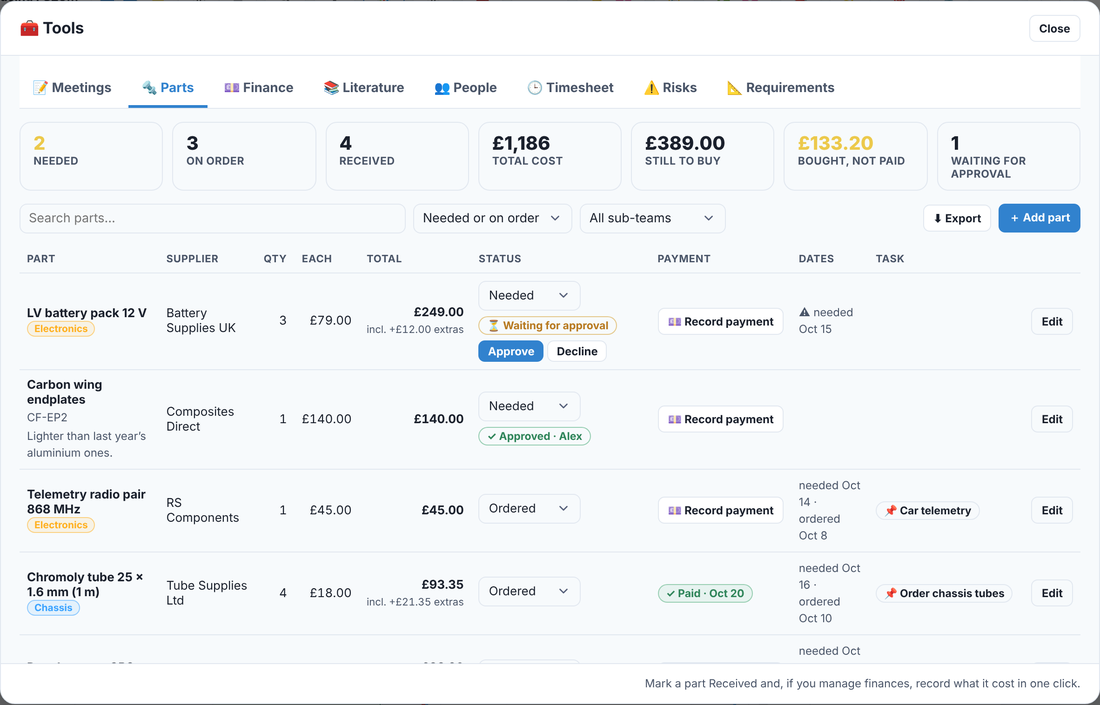
- Plan the build week by week, per person. You'll see straight away who is overloaded and which weeks clash with exams.
- Track every part's status: needed, ordered, received, machined, fitted. A part stuck at "ordered" for two weeks is a phone call, not a surprise.
- Get to a rolling chassis as early as possible. Even an incomplete car on its wheels exposes packaging problems that CAD hid.
6. Testing: put the car on the ground early
Ask any experienced team what they'd change and the answer is almost always "more testing". Every week of testing you gain is reliability you'll need in endurance. Aim to have a driving car well before competition: two to three months is a good target, more if you can.
- Plan test days like deliverables: a date, a goal (shakedown, brake test, endurance run), a checklist and someone who signs off that it's safe to run.
- Log every failure and fix. That log becomes your design report evidence and next year's lessons-learned list.
- Train drivers on the real car, not just a simulator, and rotate so you aren't relying on one person.
7. Static events: treat them as engineering deliverables
The static events (the design event, cost and manufacturing, and the business plan presentation) are worth a large share of the points, and they're judged on documents and presentations prepared months before competition. Too many teams treat them as an afterthought and write them in a panic.
- Give each submission an owner and a draft date well ahead of the official deadline.
- Build the cost report from your bill of materials as you go, not from memory at the end.
- Collect design justifications during design reviews. If you wrote down why you chose something at the time, the design report almost writes itself.
8. Competition week: arrive ready for scrutineering
Before the car can run any dynamic event, it has to pass technical inspection, and teams lose whole days here. Run your own mock scrutineering against the rules weeks before you leave, with someone who didn't build the car checking it.
- Pack from a checklist: spares, tools, fluids, safety equipment, documents.
- Agree roles for the week in advance: who talks to scrutineers, who runs the pit, who drives which event.
- Keep a simple log of every issue and fix during the week. It's gold for next season.
The weekly rhythm that holds it together
A good timeline only works if the team looks at it every week. The simplest rhythm we've seen work:
- Monday: each sub-team lead checks their people's tasks for the week and flags anything blocked: parts, machine time, a decision.
- Midweek: a 15-minute all-team stand-up. What's done, what's next, what's stuck. Decisions get an owner before the meeting ends.
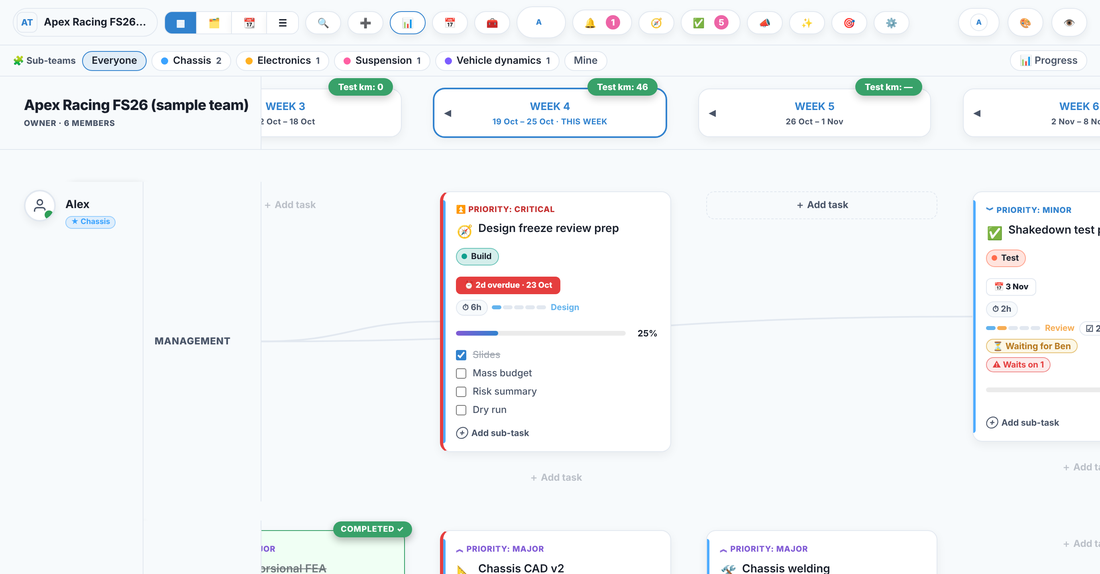
- End of week: mark what's finished, carry what isn't into next week, and check you're still on track for the next milestone. If the same task has carried over three weeks running, re-plan it, split it or drop it.
For the planning basics behind this (owners, weeks and sign-offs), see How to plan a student engineering project. For keeping parts and money under control, see How to track parts and budget for a student robotics or drone team.
Run your season on one board
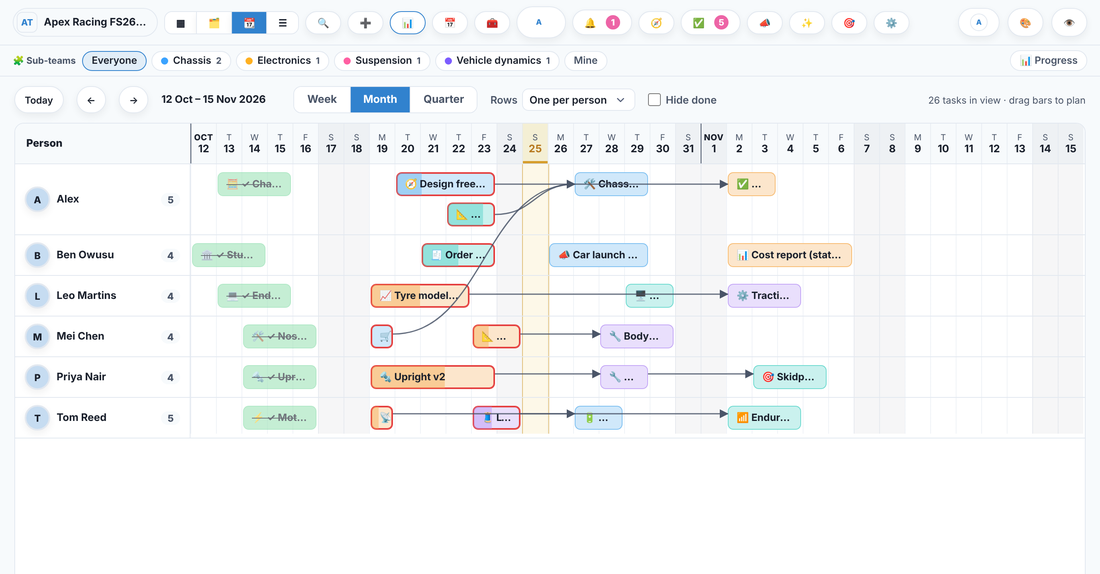
Trawpie was built for exactly this kind of team: your whole season's tasks, owners, parts, budget and design-review sign-offs on one live board, with a timeline view for the big picture. Unfinished work can carry into next week automatically, and anything that keeps slipping gets flagged.
Free for student teams of up to 30 people. Open a made-up Formula Student team in your browser, with its chassis, suspension, design freeze, dyno tests and parts. No sign-up needed.
Whatever you use, the principle doesn't change: freeze early, order early, test early, and look at the plan together every week.
See everything Trawpie does for a season on the Formula Student page.